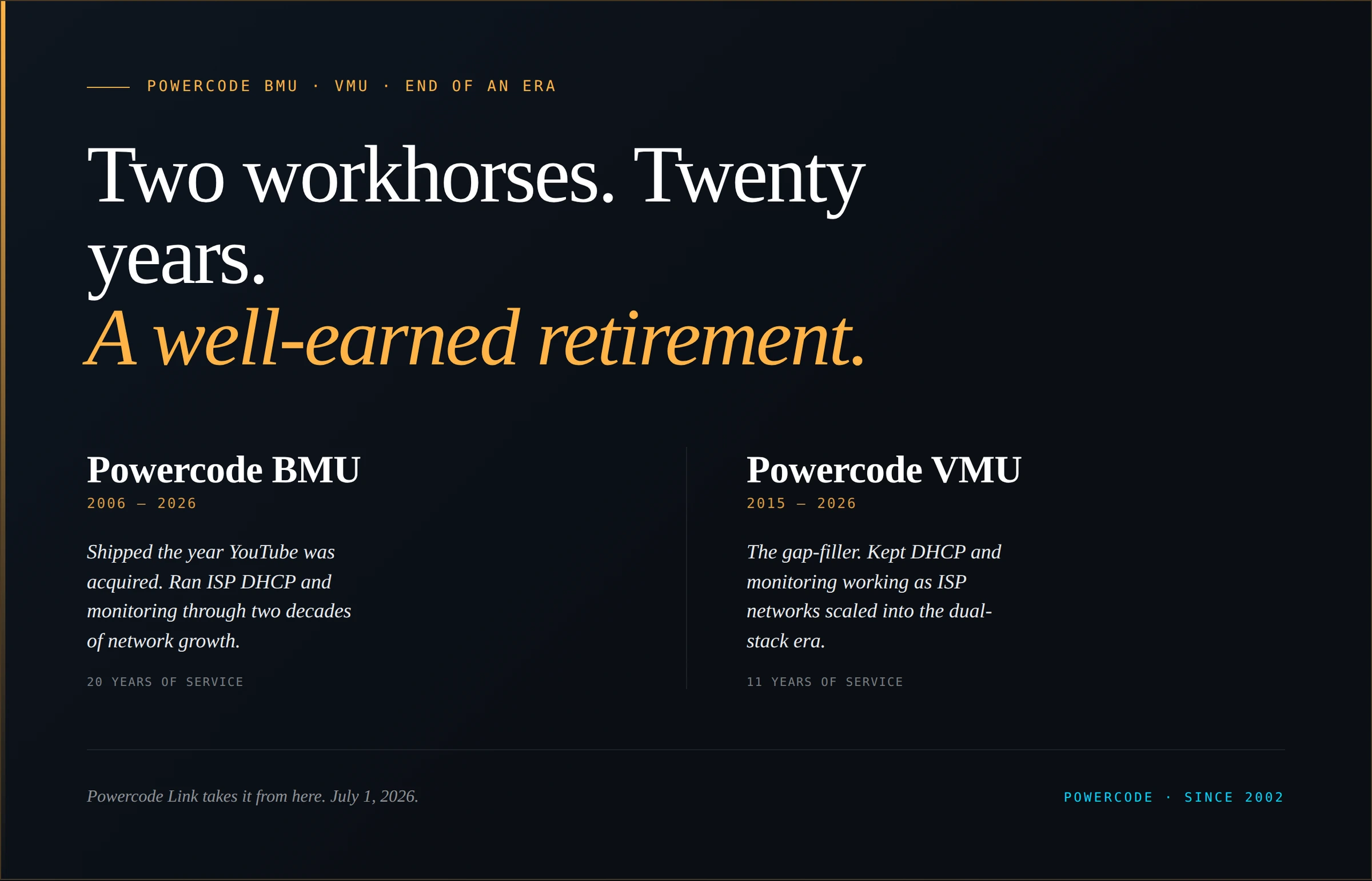
Powercode BMU (2006–2026) · Powercode VMU (2015–2026) · Twenty years of service.
With the July 1, 2026 launch of Powercode Link, Powercode is no longer implementing or installing new VMU and BMU. Updates to the VMU and BMU stop on July 1. End-of-support and end-of-maintenance dates will be announced through Powercode Command at a later date. If issues come up with VMU or BMU between now and then, our recommendation is to migrate to Link.
Powercode BMU (2006–2026) · Powercode VMU (2015–2026) · Twenty years of service.
The VMU and BMU served customers well for over a decade. They were designed for a different era of regional ISP networks. The reason they're being replaced isn't a failure on their part. It's that the networks they were built for don't exist anymore in the same form, and the tooling has to catch up.
Operators are running dual-stack at scale. Subscriber routers expect DHCPv6 with Prefix Delegation. The VMU was never built around that, and bolting it on would have produced a worse implementation than starting over.
Networks have grown ten and twenty times over since the original VMU was designed. The lease-per-second and polling demands today are different in kind, not just degree.
Operators were asking for a single tool to handle DHCP and monitoring, instead of two separate appliances with two separate UIs and manual reconciliation between them. Link does the merge.
Maintaining the VMU and BMU was competing with the engineering work going into Link, Command, and Atlas. The honest move was to commit to Link and put real planning around the transition off the old products.
The path forward for VMU and BMU operators is migration to Powercode Link. End-of-support and end-of-maintenance for VMU and BMU will be announced through Powercode Command at a later date.
Powercode stops implementing and installing new VMU and BMU. All new deployments go onto Powercode Link.
Updates to VMU and BMU stop on July 1. Active development moves to Link.
If issues arise with VMU or BMU, our recommendation is to migrate to Powercode Link. Link addresses the operational requirements VMU and BMU were not designed for.
End-of-support and end-of-maintenance for VMU and BMU will be announced through Powercode Command. Dates to be communicated at that time.
Moving from VMU and BMU to Powercode Link isn't a rebuild. It's a sync from your existing Powercode Command instance. Install Link, add it as an endpoint in Command, kick off the sync. Command writes your subnets, reservations, and equipment into Link. Most operators are serving leases from Link within an hour.
| Pre-migration | Install Powercode Link on a server. Add Link as an endpoint in your Powercode Command instance. |
| The sync | Trigger the Command-to-Link sync. Command pushes subnets, host reservations, equipment, and customer mapping into Link. |
| Cutover | Point your DHCP relays at Link. Decommission the VMU. Most operators complete this in under an hour. |
| Support involvement | Typically not needed. We're on hand for HA deployments, multi-site topologies, and any custom integrations that need a closer look. |
| Rollback | VMU stays running until you decommission it. If something goes sideways with Link, point relays back at the VMU and you're back where you started. |
| Cost | Base Powercode Link is included with your Command subscription. No license change required for the migration itself. |
The VMU and BMU did their job for over a decade. Retiring them isn't a failure of the product. It's the normal lifecycle of infrastructure software, and they earned a proper retirement.
Powercode
A thirty-minute walkthrough of Link, or a migration conversation specific to your deployment, whichever's more useful right now.