Runs the business.
The platform that regional ISPs have been calling "Powercode" for the last twenty years. Billing, customer accounts, provisioning, tickets, scheduling, inventory, reports, voice. As of the July 1 release, full IPv6 with Prefix Delegation is built in, including the pool and plan structures to provision dual-stack subscribers natively.
Same platform, same code, same team. The name caught up because there are now two siblings: Powercode Link (DHCP and monitoring, replacing the VMU and BMU) and Powercode Atlas (outside plant). Command is still where billing, customer management, and most of an ISP's day-to-day operational work happens. If you've been running Powercode, nothing breaks. You're running Command.
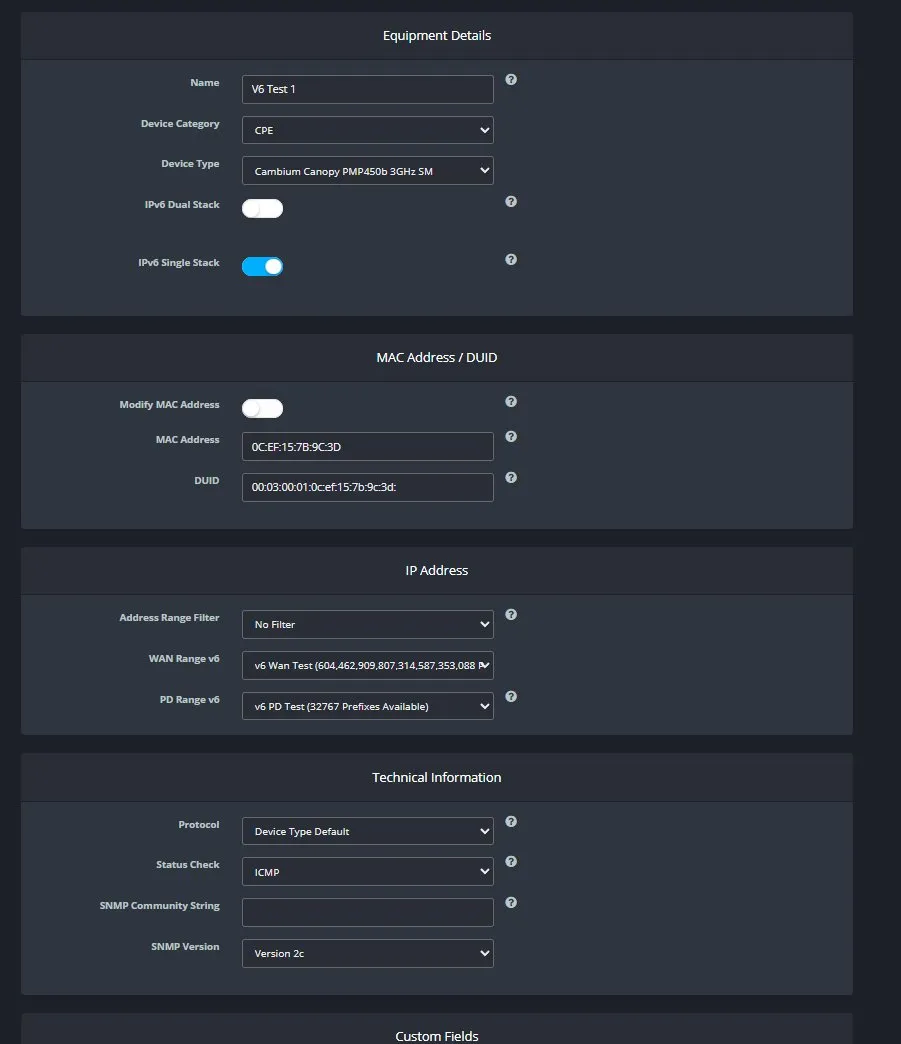
Provisioning a dual-stack customer now takes the same steps as provisioning a v4-only one. Service plans carry v4 pools, v6 pools, and delegated-prefix size as plan attributes. Customer records show both the IA_NA address and the IA_PD prefix. Reports break out IPv6 utilization the same way they break out IPv4. When Command is paired with Link, Command pushes the v6 pool config to Link and Link reports the active delegations back. This is the IPv6 story most operators have been waiting for.
| IPv4 pools | Standard pools, static reservations, CGNAT pools, prefix tagging for routing. |
| IPv6 pools | IA_NA pools for single addresses. IA_PD pools for prefix delegation, typically /56 or /60. |
| Plan templates | A plan carries the v4 pool, the v6 pool, the delegated prefix size, and lease lifetime. Set once, applied per customer. |
| Provisioning | Activate a service, Command writes the v4 reservation and the v6 pool membership to Link in one transaction. |
| Customer record | The customer view shows the active v4 address, the active v6 address, and the delegated prefix together, with lease history. |
| Reporting | Pool utilization, exhaustion alerts, and historical lease counts for both v4 and v6. |
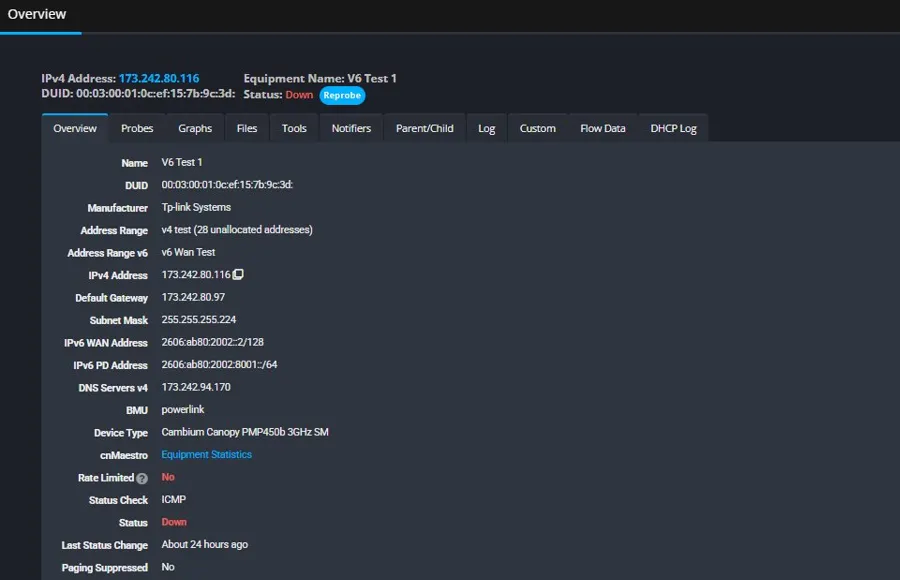
Left: A subscriber CPE record with both an IPv4 address and a full IPv6 WAN address and delegated prefix. Right: Provisioning a dual-stack subscriber. One toggle, two dropdowns, done.
Command is the system of record for customers, services, and the operational work that turns them into revenue.
Recurring billing, prorations, taxes, ACH, credit cards, payment plans, autopay. Multi-entity, multi-brand, multi-jurisdiction tax handling. Customer lifecycle from signup through churn.
Service activation, plan changes, suspensions, restorations. RADIUS-based and direct equipment provisioning. Cambium, Ubiquiti, Mimosa, MikroTik, Tarana, and a wide range of fiber CPE.
Service requests, internal tasks, escalations, SLA tracking. Email-to-ticket. Customer-visible ticket history in the portal. Notes from the field flow back into the customer record.
Tech assignment, route optimization, drive time, calendar views per crew. Field updates from a phone, customer notifications when a truck is on the way.
Equipment tracked from warehouse receipt through subscriber install. Serialized inventory, truck stock, returns, RMAs. Chain of custody on every device.
v4 pools, v6 pools, delegated prefixes, static reservations, CGNAT mapping. Pool exhaustion alerts. Direct sync with Powercode Link when both are deployed.
AR, revenue, churn, subscriber counts, MRR, plan distribution. QuickBooks integration. Custom report builder for the metrics your CFO actually asks for.
VoIP plan management, CDR rating, billing integration with major softswitch platforms. Voice handled as a normal service line, not bolted on.
White-labeled customer portal: pay bills, change services, view tickets, set up autopay. Full UAPI plus webhooks for everything else.
Fixed-wireless operators running Cambium, Ubiquiti, Mimosa, MikroTik, or Tarana. Powercode came up through the WISP industry and the WISP-specific workflows are deep. Anywhere from a couple hundred subscribers up into the tens of thousands.
GPON, XGS-PON, Active Ethernet. Command handles the BSS/OSS layer regardless of what's underneath. BEAD and grant builders use the same Command instance for the new fiber footprint as they do for legacy services.
Cable operators on DOCSIS, hybrid networks combining cable, wireless, and fiber. Multi-technology billing and provisioning that doesn't require operating three separate tools.
ILECs, CLECs, and competitive regional carriers that have outgrown spreadsheets but don't need a full enterprise BSS implementation. Command scales into the tens of thousands of subscribers without the seven-figure license fee.
Built for the carriers running tens of millions of subscribers. Implementations measured in years and seven-figure license fees. Capable, but priced for a different scale of operator.
Helped build the early WISP industry. Many were designed before fiber, IPv6, and modern integration patterns became table stakes — operators eventually hit those limits.
Newer entrants with cleaner interfaces. Your subscriber and billing data lives in their cloud, which is either a feature or a concern depending on how you think about it.
On your hardware, per-subscriber pricing, two decades of shipping, active development. Tightest fit for regional WISP, FISP, fiber, and small cable operators. 2,700+ instances in the field.
| Hosting | On-premise on your hardware. Datacenter, colo, or your own cloud account. |
| Stack | Standard server deployment. Any sysadmin can operate it. Detailed requirements provided after engagement. |
| Integrations | UAPI, webhooks, RADIUS, QuickBooks, native Link and Atlas integration. |
| Pricing | Per-subscriber, monthly. No license-renewal cliffs, no per-seat counting. |
| Support | Direct to the team that builds it. No tier-one routing layer between you and an engineer. |
We run our own ISP on Command. Every customer, every ticket, every truck roll. If something doesn't work for us, it doesn't ship to anybody else either.
Tim Wright · Powercode
Thirty minutes, end to end. We'll show whichever pieces of the platform actually map to what you're trying to solve.